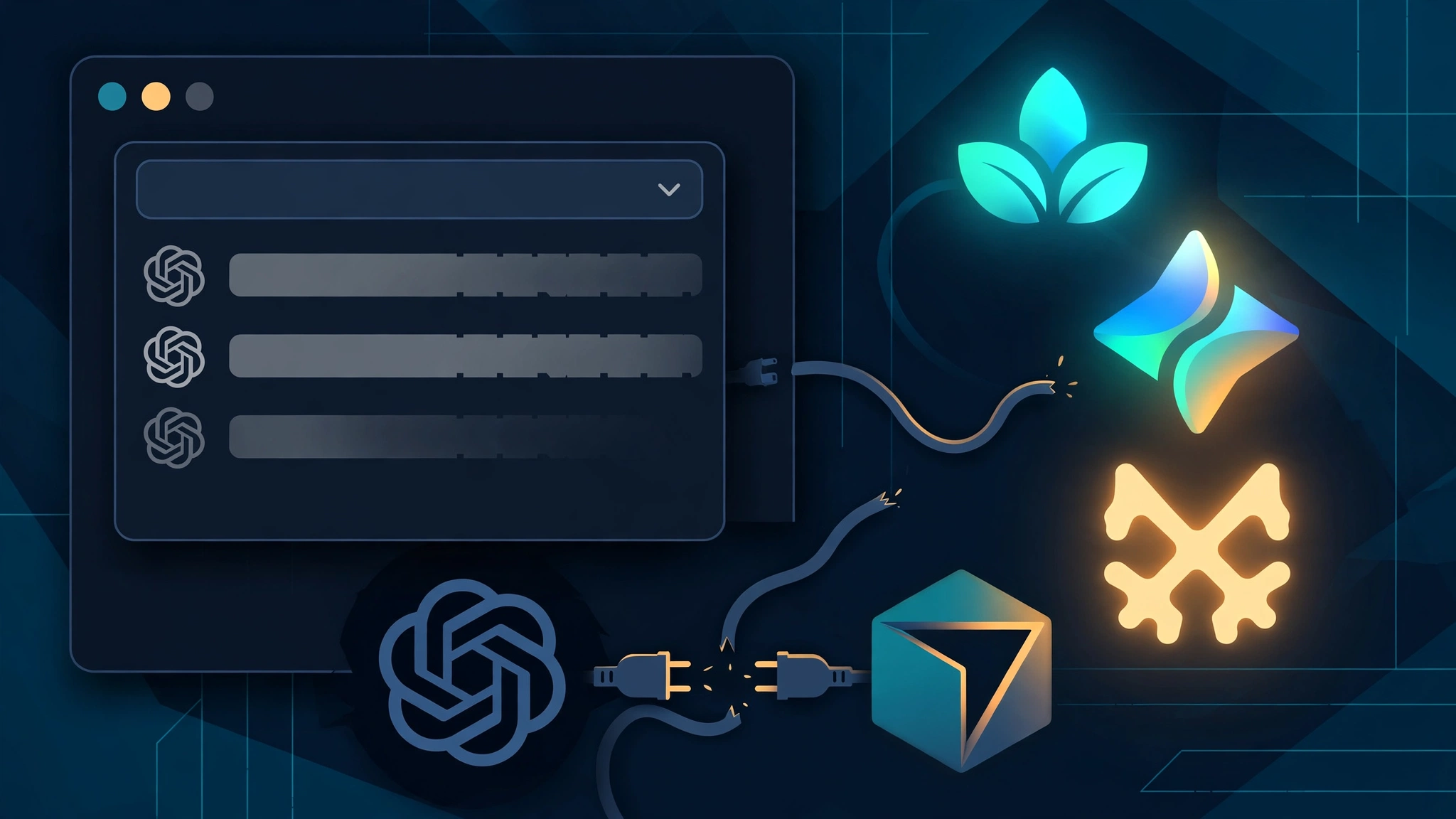
OpenAI Leaves Cursor: GPT May Go Dark on Nov 12
You open Cursor this morning, type a familiar prompt — and GPT-5.6 Sol may be gone from the model picker. November 12, 2026 is the date OpenAI proposed to end its model-supply contract with Cursor. Proposed, not final — that distinction decides how you should act.
What exactly changes?
OpenAI’s announcement on August 28, 2026
On August 28, 2026, OpenAI announced that after SpaceX acquired Anysphere, it would wind down the model-supply contract, with a proposed date of November 12, 2026 — the maximum notice the contract allows — and supply no new models. Its stated reason: it cannot be confident SpaceX will use its technology within the terms of service, citing Musk’s companies’ record of violating contracts.
November 12 is a proposed date, not a confirmed cutoff
OpenAI’s help page says: “We have proposed a transition period of November 12, 2026… Cursor may choose to end access sooner. We will share the official termination date as soon as it is confirmed between both companies.”
As of this morning (~11:15 Vietnam time), neither side has confirmed the cutoff takes effect today.
SpaceX bought Cursor
SpaceX, through SpaceXAI, acquired Anysphere — Cursor’s parent — in an all-stock deal reported at $60 billion, closed August 14, 2026 (press-reported, not an official filing).
Who is actually affected?
The CEO’s 5% figure — and why it misleads
On the night of August 28, Cursor CEO Michael Truell wrote on X that OpenAI models serve about 5% of Cursor traffic. But 5% only counts people who pick GPT directly — it misses a much larger, less visible group: Auto users.
Auto users carry a bigger hidden risk
In Auto mode, the Cursor Router distributes requests across GPT-5.5, Claude Opus 5, Grok 4.5 and Claude Fable 5 — so Auto users who never picked GPT may still have been running on GPT-5.5 without knowing it. If the GPT channel is shut off, the Auto pool shrinks and quality can change without warning. Check your default model and review team templates that still mention GPT.
Which models remain?
As of October 26, Cursor’s models page listed three OpenAI models: GPT-5.6 Luna, Sol and Terra — Cursor never received GPT-6.1 Sol, because OpenAI stopped sending new models after August. What remains: Claude, Gemini, Grok, Moonshot, Z.ai and Composer. Anthropic co-founder Tom Brown committed that night to more compute for Claude in Cursor.
Where your request goes inside Cursor
Cursor does not run GPT models itself — it is a middle layer: you pick a model, the request goes through the Cursor Router to the provider’s API, and the result returns to Chat, Agent, Tab or Cloud Agent. The break point is the contract, not a feature — the only thing that can disappear is one provider branch.
A limit many will misunderstand: plugging your own OpenAI API key into Cursor only works with local Chat and Agent — Tab, Auto, Cloud/Background Agents, Automations, CLI and the Cursor API do not accept user credentials.
Why can OpenAI cut access at all? The change-of-control clause: when the parent company changes hands, the model provider may terminate the contract within a limited window. Anthropic did the same to OpenAI in August 2025 — while keeping access for benchmarking and safety evaluations.
flowchart TD
    User["Cursor user"]
    ModelPicker["Model picker<br/>GPT-5.6, Claude, Gemini, Grok, Auto"]
    Router["Cursor Router / API gateway"]
    OpenAIContract["Cursor–OpenAI contract<br/>proposed end Nov 12"]
    GPTBlocked["GPT via Cursor contract<br/>PROPOSED cut Nov 12"]
    ClaudeAlive["Claude<br/>still working — more compute promised"]
    GeminiGrokAlive["Gemini / Grok / Moonshot / Z.ai / Composer<br/>still working"]
    OwnKey["Your own OpenAI API key"]
    KeyLimits["Local Chat and Agent only<br/>NOT Tab, Auto, Cloud, Automations, CLI, API"]
    CodexExt["Codex extension INSIDE Cursor<br/>separate panel"]
    CodexExit["Leave Cursor: Codex CLI / OpenAI app"]
    Done["Result returned to the user"]

    User --> ModelPicker
    ModelPicker --> Router
    Router --> OpenAIContract
    OpenAIContract --> GPTBlocked
    Router --> ClaudeAlive
    ClaudeAlive --> Done
    Router --> GeminiGrokAlive
    GeminiGrokAlive --> Done
    ModelPicker --> OwnKey
    OwnKey --> KeyLimits
    KeyLimits --> Done
    User --> CodexExt
    CodexExt --> Done
    User --> CodexExit
    CodexExit --> Done
In short: the break point is the contract; GPT is the only branch proposed for removal; a personal API key only saves local Chat and Agent; the Codex extension keeps the newest GPT inside Cursor.
What to do today
Step 0 — Check before you switch (2 minutes)
Go to Settings → Models: are GPT-5.6 Sol, Luna and Terra still listed? Note your default model; if you use Auto, pick a replacement in advance. Quick test: open a new Chat, pick Claude, send a test prompt.
Route 1 — Switch to Claude, Gemini or Grok (recommended for most)
Change the default in Chat and Agent to Claude — the main alternative, backed by Anthropic’s public compute commitment; use Gemini or Grok when a task suits them. For the newest Claude models in Cursor, see Claude Fable 5.2 and Mythos 5.2: When Is It Worth It?.
Don’t lock in a team-wide default on day one: run one familiar task — a bug fix, a test — then compare with GPT. The most common failure is not a worse model, but prompts and rules written for GPT.
Route 2 — Plug in your own OpenAI API key (local Chat and Agent only)
Use your own key and pay OpenAI directly by usage, bypassing the Cursor–OpenAI contract. But a personal key does not apply to Tab, Auto, Cloud/Background Agents, Automations, CLI or the Cursor API — a workflow living on Tab or background Cloud Agents cannot be saved by one.
Treat a personal key as a secret: don’t commit it to a repo, don’t share it over chat, store it in an environment variable or secret manager, track costs, rotate it when someone leaves. Rollback: remove the key from Cursor.
Route 3a — Use Codex inside Cursor via OpenAI’s IDE extension
OpenAI’s Codex IDE extension runs a separate panel inside Cursor. To install: open Extensions (Ctrl+Shift+X), search for “Codex” by OpenAI — extension ID openai.chatgpt — then Install; sign in with an eligible ChatGPT account or an OpenAI API key. The extension does not change the models used by Cursor Chat, Agent, Tab, Auto or Cloud Agents — Tab, Composer and Cloud Agent stay intact; Codex runs alongside in its own panel.
This is how you get the newest OpenAI models back, including GPT-6.1 Sol, without leaving. Limitation: your Cursor prompts, rules and history do not flow into Codex; you work with two agents in parallel.
Route 3b — Leave Cursor for the Codex CLI or OpenAI app
This only fits a pure Codex workflow: you regain direct access to OpenAI models, but lose Tab, Composer and Cloud Agent, and must rebuild your workflow elsewhere.
Checklist for teams and IT managers
Tell the team the new default model, the effective date, and who to contact; update docs, rules and prompt templates that still mention GPT. A team on personal API keys pays by usage — very different from a fixed Cursor plan.
Switching away from GPT: what you gain and lose
Switching to Claude, Gemini or Grok does not interrupt your work: the remaining providers still operate under their own contracts. But you lose the newest OpenAI models inside Cursor — no GPT-6.1 Sol, no future models through the Cursor–OpenAI contract — and no verified benchmark shows the replacement beats GPT-5.6 Sol.
With a personal API key, you trade for higher costs, key-leak risk, and the loss of Tab, Auto and Cloud. No option keeps all three at once — the newest OpenAI models, the full Cursor feature set, a fixed plan price — except the Codex extension.
Comparing the alternatives to GPT
| Criteria | Claude | Gemini / Grok | Own API key | Codex extension | Codex CLI / app |
|---|---|---|---|---|---|
| Still in Cursor | Yes | Yes | Local Chat/Agent only | Yes (separate panel) | No — leaves Cursor |
| Newest OpenAI model | No | No | Yes | Yes | Yes |
| Tab / Auto / Cloud | Yes | Yes | No | Yes | No |
| Cost | Cursor plan | Cursor plan | OpenAI usage | OpenAI pricing | OpenAI pricing |
| Provider lockout risk | Depends on Anthropic | Depends on Google/xAI | Low (your key) | Depends on OpenAI | Depends on OpenAI |
| Best for | Most users | Tasks suited to Gemini/Grok | Need GPT in Chat/Agent | Need the newest GPT | Pure Codex workflow |
Model access as strategic leverage
This is the second time in just over a year that model access has been used as contract leverage — Anthropic cut OpenAI in August 2025, OpenAI cut Cursor in August 2026 — and in the same week Meta bought Conductor, an orchestration tool for coding agents (Meta Acquires Conductor).
In my view, the notable thing is not “losing GPT” but the precedent: a team depending on one editor + model combo is betting on a contract it did not sign.
Real cases — who should do what?
- Individual — GPT directly or Auto: switch the default to Claude, test it for one working day, then commit.
- DevOps/SRE and IT managers: send an internal notice, update rules and prompt templates, set a team-standard model; assess provider-lockout risk and consider multi-provider policy.
- Teams that must have the newest GPT: try route 3a (Codex extension) first; leave for the Codex CLI (3b) only for a pure Codex workflow.
Lessons learned
- Don’t lock your team’s workflow to one editor + model combo you don’t control.
- Aggregate numbers (5% of traffic) can hide real exposure — Auto users prove it.
- A proposed date is not a confirmed date: check the official source before acting.
- Every workaround has limits written in the docs — a personal API key does not save Tab, Auto or Cloud Agent.
- When a provider cuts access, the best option is usually the one that publicly committed compute.
- Standardize the team’s default model early — before an incident forces you to.
Conclusion
Staying in Cursor and switching models fits most users. Teams that must have the newest OpenAI models inside Cursor Chat, Agent or Tab have two paths: the Codex extension (separate panel) or the Codex CLI.
Next step: check the models in Cursor today, pick one replacement, run it for a working day, then commit.
Verification scope
Checked: November 12, 2026 (re-checked ~11:15, Vietnam time). Verified against OpenAI’s official blog and help page (August 28, 2026) and reporting from CNBC and Times of India; API-key limits, the Auto Router model list and the Codex extension come from Cursor and OpenAI documentation via secondary reporting. GPT-6.1 Sol is a real OpenAI model (released October 26, 2026, in OpenAI’s Codex and API, never shipped to Cursor) per getmegabrain and enjoy.dev. November 12 is only a proposed date — as of the re-check, neither side has confirmed the cutoff takes effect today.
The $60 billion figure is press-reported, not from official filings; this article installs or tests no software.
References
- OpenAI — “Our decision on Cursor following its acquisition by SpaceX” (28/8/2026): https://openai.com/index/our-decision-on-cursor-following-its-acquisition-by-spacex/
- OpenAI Help Center — “Using OpenAI models in Cursor”: https://help.openai.com/en/articles/20001506-using-openai-models-in-cursor
- CNBC — “OpenAI to end model access to Cursor after acquisition by Elon Musk’s SpaceX” (29/8/2026): https://www.cnbc.com/2026/08/29/openai-cursor-spacex-model-access.html
- Zentor — “OpenAI models not available in Cursor”: https://zentor.ai/blog/openai-models-not-available-in-cursor
- Enjoy.dev — “OpenAI plans to cut Cursor off on November 12. How to keep using GPT there” (24/10/2026): https://enjoy.dev/blog/cursor-openai-november-12/
- Times of India — “OpenAI to end model access to Cursor”: https://timesofindia.indiatimes.com/articleshowprint/133611738.cms
- getmegabrain — “Cursor’s Best OpenAI Model Costs $7.98 Per Coding Test. The GPT-6.1 Sol It Never Got…” (7/11/2026): https://api.getmegabrain.com/blog/cursor-openai-cutoff-gpt-5-6-sol-vs-gpt-6-1-sol-2026
Bình luận
Bình luận được duyệt trước khi hiển thị.Đang tải bình luận…
Để lại bình luận