Do AI Agents Really Work? The Real Numbers
On Monday morning, your boss drops a video into the team chat: an AI agent ordering food, calling a car, booking a hotel — one sentence does it all. “When are we using this?” The demo looks smooth. But you remember the last chatbot refund: polite reply, correct template, tidy log — completely wrong.
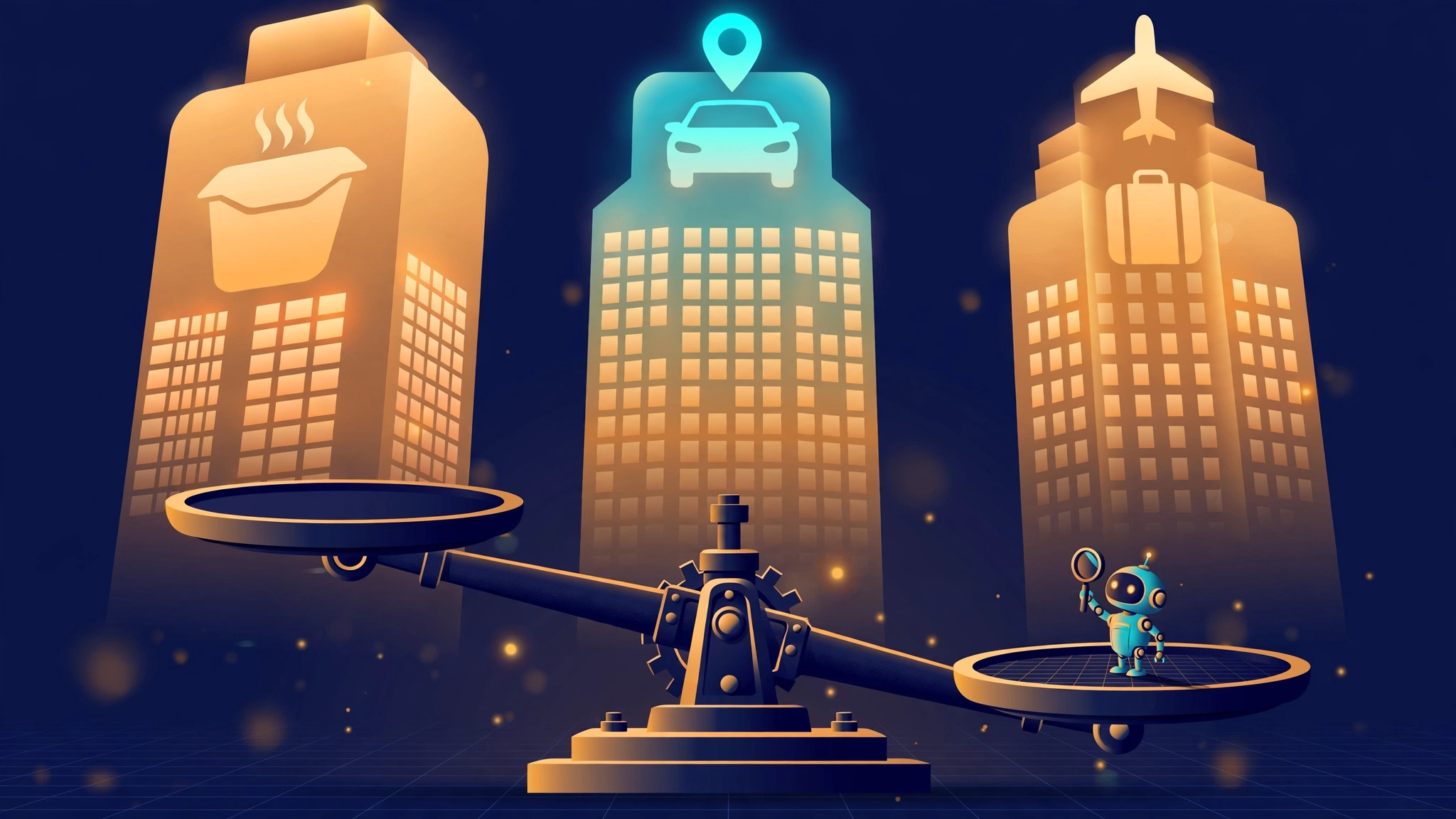
The question is not whether agents are “smart” — it is how many people hand work to an agent in real life. In one week, the three biggest companies in delivery, ride-hailing and travel published their numbers — all three shockingly small. This article puts them side by side: what can agents do now, and what not to hand over yet?
What the hype says
In summer 2026, AI agents were tech’s hottest topic. Instinct — an agent living in text messages — went viral in Silicon Valley, then raised $1 billion at a $10 billion valuation in September, per TechCrunch. Meta launched Muse, OpenAI has Dots, Anthropic’s Claude Duet is on waitlist. The pitch: one sentence, and the agent orders food, calls a car, books a room.
The strongest claim is that “agents will replace apps”. But a demo is not real usage. Nilay Patel of The Verge calls this “X is not real life” — on social media, everyone assumes Muse, Instinct, Dots and Claude Duet are mainstream products. The companies’ own numbers tell a different story.
Three numbers in one week
Between 29 October and 5 November 2026, three companies disclosed AI agent numbers in Q3 earnings — the first time these figures were public, and all three are tiny.
| Platform | Orders from AI agents | Total volume for comparison | Source |
|---|---|---|---|
| DoorDash | A few hundred orders (running total) | 993 million orders in Q3 2026 | TechCrunch, 30 Oct 2026 |
| Uber | 4 rides; about 500 Uber Eats orders (Halloween week) | About 320 million trips and orders in Halloween week; 4.1 billion trips in the quarter | The Verge, 4 Nov 2026 |
| Airbnb | “Very few”, “very non-material” | About 500,000 bookings per day | Business Insider, 6 Nov 2026 |
DoorDash: a few hundred orders. On the Q3 call on 29 October, CEO Tony Xu said third-party agents — Muse, Instinct, Fo — had placed “maybe several hundred orders in total”. That quarter, DoorDash handled 993 million orders, up 28%. DoorDash does not block these agents; it opened an MCP tool for corporate ordering. The door is open, but almost nobody walked through it.
Uber: four rides. On the Q3 call on 4 November, CFO Balaji Krishnamurthy said: “For our rides business, it was a grand total of four trips that we fulfilled from agents.” Four trips — not four thousand, not four million. He called usage “very, very early and very limited”. Uber Eats did better: about 500 agent orders in Halloween week, against about 320 million trips and orders that week.
Airbnb: almost zero. On the Q3 call on 5 November, CEO Brian Chesky said: “We’re not seeing a lot of traffic, and even fewer bookings, from Muse and Instinct yet.” Agent bookings were “very non-material” out of nearly 500,000 bookings a day; traffic peaked in early October and has been flat since. His position: “I don’t see them as a threat.” He sees agents like Google — a channel for people to discover Airbnb.
Ordering through an AI agent is still so rare it barely registers against total volume.
Reading the numbers correctly
All three numbers are easy to misread — “agents are dead” or “too early”. Three points matter.
First, DoorDash’s “several hundred” is a running total, not one quarter. It is the total since these agents started. The correct denominator is 993 million orders in Q3 — take the generous end, 900 orders: still under one in a million. The “3 million orders a day” figure comes from DoorDash’s 2024 Dash Report, US deliveries only — a different period and scope. Comparing a few hundred with 3 million a day is apples and oranges.
Second, Uber’s numbers cover different periods. The Verge reports the four rides as a Q3 figure, TechCrunch places them in Halloween week; the 500 Uber Eats orders are from Halloween week; 320 million is the week’s total; 4.1 billion the quarter’s trips. No clean rate can be computed. The only conclusion that holds either way: the share is effectively zero.
Third, the data only counts agents that can be identified. An agent that opens a normal browser and clicks through checkout looks like a human. The real figure may be higher — but even times ten, agent ordering would still be a rounding error.
The numbers do not prove agents are “dead”, nor about to explode. They prove one thing: as of today, almost nobody hands shopping, travel or transport to an agent.
Why users don’t hand work to agents yet
The small numbers are not an accident — all three reasons are about the delegated task, not the agent’s intelligence.
Real money, real decisions. A ride, a meal, a room involve real money and real time — one wrong address loses money, one wrong day misses a flight. Users still want to press the final button themselves — that is where responsibility stays. On Threads, people describe agents booking the wrong thing, unable to cancel, reporting back after the money was gone. A task whose consequences cannot be undone is not handed to a system people do not yet trust.
Travel is an experience, not a chore. Chesky put it memorably: “Travel is aspirational.” By his account, 80% of travellers enjoy planning trips, 90% message their host, each looks at a dozen listings and swipes through about 25 photos per listing. Handing everything to an agent means giving up the most enjoyable part of the trip — some things people want to do themselves.
Trust is not there yet, and the metric is wrong. On Threads, @stephenbeck asked a question that drew 260 likes and 36 comments: is user demand for agents overstated, when the tech industry is the loudest promoter? @tempofeng (56 likes, 27 comments) argues agents should run on demand — called when needed, then stopped — not “owning many agents running continuously”. @nahiddotai (25 likes, 21 comments): status is not measured by how many agents you run at once. @carnage4life (160 likes, 38 comments) uses the DoorDash and Airbnb stories against “agents will replace apps”. The message is consistent: users do not yet trust agents with important work.
Where agents work well right now
Agents have not cracked consumer spending — but they are not useless. They work where results can be verified, and struggle where they must be taken on faith.
Coding is the strongest area. @stanleywangg, a senior data analyst, urges viewers to learn Codex and Claude Code — 360 likes. The reason: code has tests, diffs and rollbacks. Bad code fails tests, a reviewer sees it in the diff, a bad merge can be reverted. Orca — Run Multiple AI Coding Agents in Parallel on this blog shows the same logic: run several agents at once, review each diff, merge the best.
In-house customer support. Airbnb itself — the company that just said outside agents bring almost no bookings — uses its own AI to resolve about 40% of support requests with no human; support cost per booking fell more than 17%. The difference is where the AI sits: inside the company’s system, with full data, clear processes, tight limits.
Low-risk, reversible work. Booking a table, scheduling, drafting, summarising — mistakes take a minute to fix, cost nothing. Agents are useful here, and users delegate here first.
On demand, not always on. @tempofeng makes a point worth remembering: call an agent when needed, then stop it — rather than a “team of agents” running around the clock. Running continuously costs money and compute and creates more surface for errors. In my view, the practical advice for teams deploying agents: start on demand, measure results, then consider deeper automation.
To check whether your agent is doing its job, audit its behaviour through simulations and grade it with evidence — see iFixAi — Independent AI Agent Audit.
Should you hand this task to an AI agent?
flowchart TD
    A[Task to do] --> B{Does it involve money or\na hard-to-reverse decision?}
    B -->|Yes| C{Can the result be checked\nbefore confirming?}
    B -->|No| D[Hand it to the agent,\nreview the result]
    C -->|Yes, checkable| E[Hand it to the agent,\napprove before paying]
    C -->|No| F[Do it yourself, or use the agent\nonly to prepare, not to confirm]
    D --> G[Done]
    E --> G
    F --> G
The diagram packs the article into one question: can this task be undone and verified before confirming? Both yes, and the agent is a good choice. Either no, and the final click stays with a human.
Who should use agents now, and who should wait
| Who | What to do now |
|---|---|
| Developers, engineering teams | Coding agents with diff review; run in parallel, merge the best |
| Customer support teams | Agents inside your system; measure self-resolution rate and cost |
| End users | Agents for low-risk work; press the payment button yourself |
| Merchants and booking businesses | Don’t rebuild around agents; open an agent channel (MCP), keep the app main |
| Agent product builders | Measure real completed transactions, not demos |
Lessons learned
- Hype is not demand. Investment and demo views do not predict how many people hand work to an agent. Count real transactions, not attention.
- Compare like with like. DoorDash’s “several hundred” is a running total; 993 million is one quarter. Dividing a cumulative numerator by a quarterly denominator, or comparing with 2024, is wrong.
- Users delegate low-risk work first. Scheduling, drafting and summarising before payments and bookings. Roll out agents in order of increasing risk, not newest features.
- Agents are strongest where results can be verified. Code has tests and diffs; support has processes and data. Where results can be checked before confirming, agents deliver; where they must be taken on faith, they should not stand alone.
- “Running many agents” is not a metric. The number of agents running at once says nothing about effectiveness. One on-demand agent that finishes its task beats ten running continuously with nobody checking.
- Do not build strategy on the assumption that agents will replace apps. The big platforms still treat the app as the main channel and agents as discovery and supplement — Airbnb is building its own travel agent, DoorDash opened MCP for corporate ordering, both keeping control of the experience and the transaction.
Verification scope
- Date checked: 7 November 2026.
- Verified: DoorDash (TechCrunch, 30 October 2026, Q3 call of 29 October); Uber (The Verge, 4 November 2026, Q3 call the same day); Airbnb (Business Insider, 6 November 2026, Q3 call of 5 November). Threads counts checked directly across 50 English-language posts from 1–7 November 2026.
- Default vs opt-in: Muse, Instinct and Dots are third-party services users actively choose; no platform enables agent ordering by default. The DoorDash and Uber counts cover only identifiable third-party agents.
- Configuration vs benchmark: all figures here are business numbers disclosed by the companies, not performance benchmarks or controlled test results.
- Not tested: I did not run an agent to book a ride, order food or reserve a room, so I measured no success or failure rate; this article draws no conclusion about the quality of any specific agent.
Sources
- TechCrunch, “DoorDash said it’s only received ‘several hundred’ orders from AI agents”, 30 Oct 2026: https://techcrunch.com/2026/10/30/doordash-said-its-only-received-several-hundred-orders-from-ai-agents/
- The Verge, “Uber only fulfilled 4 rides from AI agents last quarter”, 4 Nov 2026: https://www.theverge.com/transportation/1026306/uber-ai-agents-q3-earnings-disintermediation
- Business Insider (via Fonqast), “Airbnb CEO Says AI Agents Like Muse Are No Threat”, 6 Nov 2026: https://www.fonqast.com/news/airbnb-ceo-says-ai-agents-like-muse-and-instinct-are-barely-bringing-in-bookings
- Threads: @stephenbeck, https://www.threads.com/@stephenbeck/post/DfYTTevmvNf; @carnage4life, https://www.threads.com/@carnage4life/post/DfZzPODGx8H; @tempofeng, https://www.threads.com/@tempofeng/post/DfYsOQSIBET; @nahiddotai, https://www.threads.com/@nahiddotai/post/DfSH3kjjYzI
Bình luận
Bình luận được duyệt trước khi hiển thị.Đang tải bình luận…
Để lại bình luận